
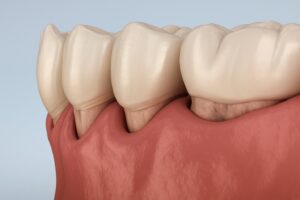
If you’re unfamiliar with the term “periodontal pockets,” you might be confused when your periodontist says you have them. What are they, exactly? Should you be concerned? If you’re living with gum disease and experience this side effect, your dentist can help. Keep reading to learn more about this development and what you and your periodontal team can do to treat it.
What Are Periodontal Pockets?
Your gums help hold your teeth in place, but when periodontitis occurs, your soft tissues will begin to recede. Also known as gum recession and periodontal pockets, these gaps form around your teeth and easily trap bacteria. Over time, the infection will damage your bone, making it harder for your teeth to remain in place.
Periodontists measure these pockets as part of a charting process. While 1-3 mm is normal, anything that is 4 mm or above can signal gum disease. Once they reach 5-7 mm, you’re dealing with moderate periodontitis, and 7-12 mm is advanced.
The longer you wait to undergo treatment, the more severe the infection becomes. It can impact not only your smile but also your overall health, including your heart, brain, and lungs.
How Can a Dentist Treat Periodontal Pockets?
To close these gaps and prevent them from returning, you’ll first need to meet with your periodontist. They’ll assess your gum pockets by measuring their depth and determine the severity of your gum disease.
Based on their findings, they will recommend effective treatment options designed to target infection, close periodontal pockets, and reduce future bacterial accumulation. You may need a deep cleaning, or scaling and root planing, laser gum disease treatment, tray delivery, a gum graft, or another similar solution.
Whether it’s smoothing the tooth roots to discourage future buildup, delivering medication through customized trays to target hard-to-reach areas of bacteria, or restoring recessed gums by placing healthy tissue over exposed roots, these treatment options can improve your gum health and reduce periodontal pockets.
If your dentist says you have periodontal pockets, don’t ignore or put off treatment. Get the help you need right away so that you can spend your life with a healthier, disease-free smile.
About the Author
Dr. Ankur Patel is a board-certified periodontist in Katy who earned his Master of Science degree and his Certificate of Advanced Specialty in Periodontics upon completing a three-year residency at the University of Illinois. He is certified in Pinhole Surgical Technique™ and oral and IV sedation. He finds the surgical and intellectual aspects of periodontics rewarding and enjoys helping patients achieve healthier gums. If you think you might benefit from periodontal treatment, visit our website or call (281) 849–4003 to schedule an appointment.